In short
- An in depth interview (IDI) is a one on one conversation, usually 45 to 60 minutes, that follows one buyer's story in detail.
- Buyers don't always do what they say, say what they think, or know why they acted. Asking what happened, step by step, gets past all three.
- 8 to 12 buyers of one type is usually enough. In one well known study, 6 interviews already turned up 34 of the 36 main themes.
- Your post purchase survey responses tell you whom to call, from the channel each buyer named to what almost stopped them.
- End by turning what you heard into answer options and counting them on every order with a post purchase survey app.
What an in depth interview is
In an in depth interview, one trained interviewer talks with one person about one topic, usually by video call. The interviewer has a guide with the topics to cover, but follows the person wherever the story goes. The aim is to understand the context, motives, worries and trade offs behind a decision, in that person's own words.
Compared with a focus group discussion, nobody else is in the room, so people say things they would keep to themselves in a group. Compared with a survey, you can ask "and then what?" as many times as you need.
Interviews fit a Shopify store best when:
- The decision takes a long time, such as furniture, a mattress, a camera or anything over a few hundred dollars.
- The topic is private, such as skin, weight, health, money or a gift for a partner.
- You want to know why people left, such as buyers who returned an order or subscribers who cancelled.
- The buyer is a business, such as a café that orders your coffee beans wholesale.
Why buyers' answers and actions don't match
Ask a buyer why they ordered, and you get a tidy reason. It is rarely the whole story, for three reasons:
- They don't do what they say. "I'd buy the refill every month" sounds sure in October, and then life gets busy.
- They don't say what they think. Not to lie, but to look sensible. "I compared the ingredients" is easier to say than "my friend's skin looked great at her wedding."
- They don't know why they did it. Much of shopping runs on habit and feeling, and the reason gets made up afterwards.
People remember events far better than they explain them. So a good interview asks about one real order, in the order things happened, with as many details as the buyer can recall, such as the day, the place, the screen and the person next to them. The reasons come out of the story without being asked for.
Who to interview, and how many
Pick buyers by what you want to learn. If you already run a post purchase survey, the responses tell you who is who:
| Buyer to call | How to find them | What you learn |
|---|---|---|
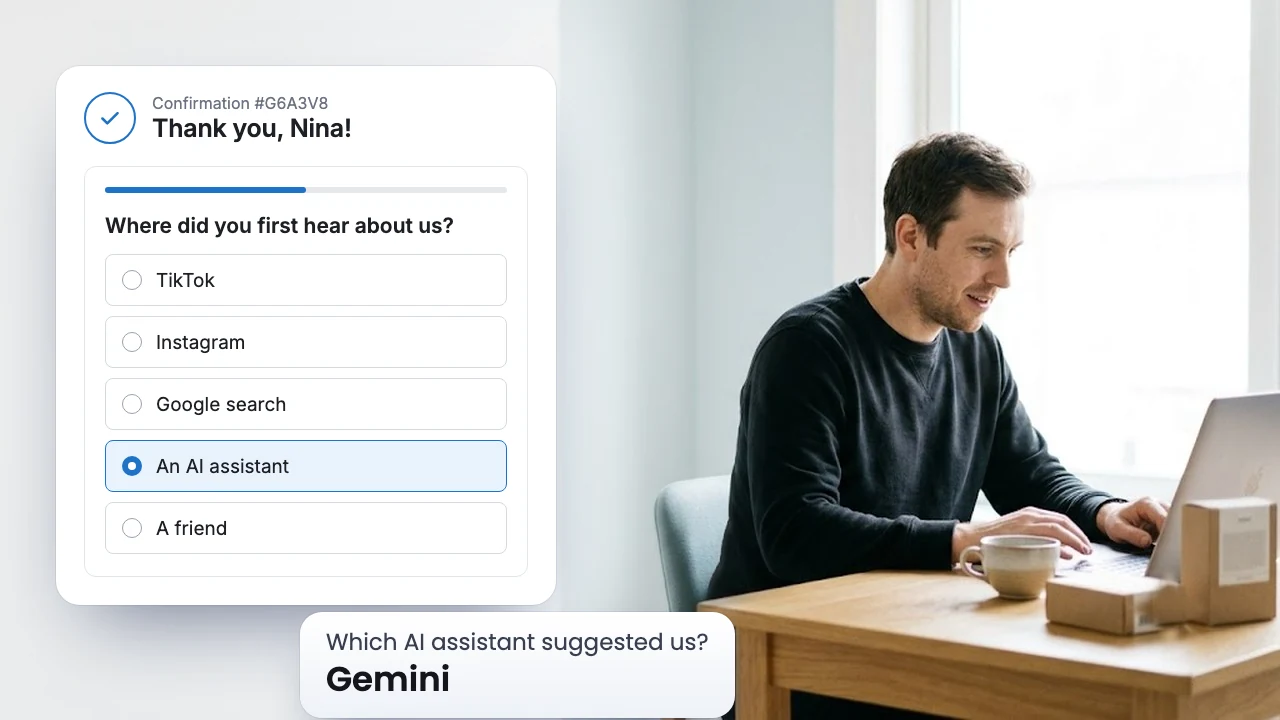
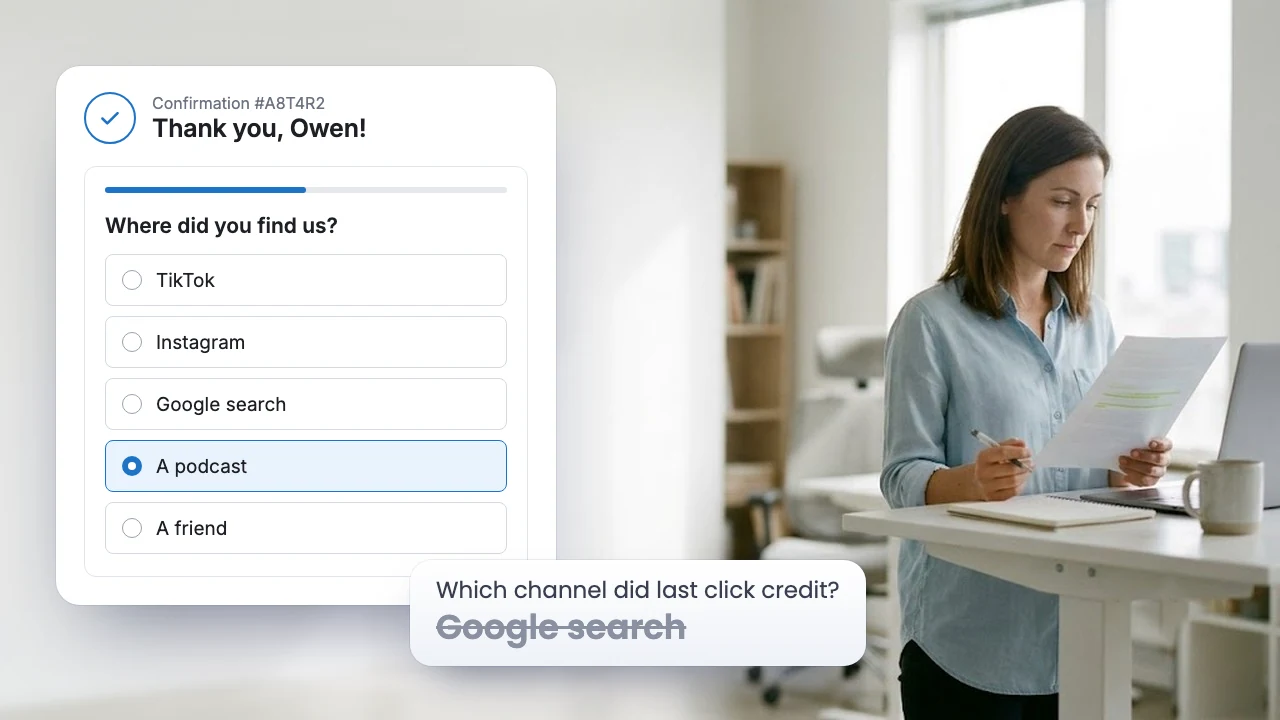
| First time buyers from a new channel | They picked TikTok or ChatGPT in "Where did you first hear about us?" | What made a stranger trust you |
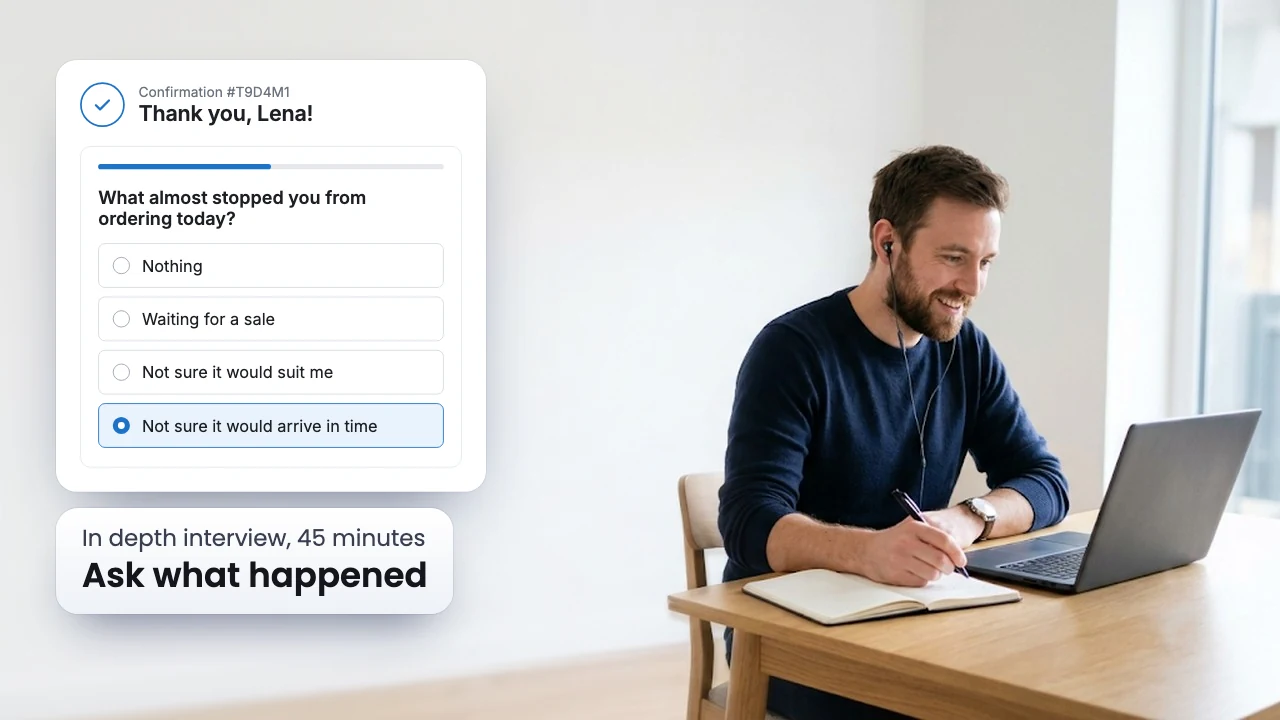
| Buyers who almost didn't order | They picked anything but "Nothing" in "What almost stopped you from ordering today?" | The doubts your product page has to answer |
| Gift buyers | They picked "Someone else" in "Who is this order for?" | How people choose for someone they shop for |
| Repeat buyers | Their second order or later | Why they came back, and how they describe you to friends |
| Buyers who returned an order | Your returns list | What the page promised that the product didn't keep |
Interview each type separately, and in the two weeks after the order, while the buyer still remembers the evening they ordered.
As for how many, researchers Greg Guest, Arwen Bunce and Laura Johnson ran 60 interviews and checked after every 6 how many new themes had appeared.
In product research, Abbie Griffin and John Hauser estimated that 20 to 30 interviews uncover 90 to 95% of customer needs. For one type of buyer and one clear question, plan 8 to 12 interviews, and stop when two or three in a row bring nothing new. Interview more when your buyers are very different from each other or the question is broad.
To find people, add one question to the Thank you page:
A 45 minute interview guide
The guide moves from the person, to their habits, to one real order, and only then to your store. Asking about your store first makes people polite for the rest of the call.
| Part | Minutes | Goal | Questions to ask |
|---|---|---|---|
| Warm up | 5 | Make it safe to criticize you | "There are no right answers. If something on our site annoyed you, that is the most useful thing you can tell me." |
| Their life | 10 | Context for the need | "What does a normal weekday look like for you?" "Where does skincare fit into it?" |
| The order, step by step | 20 | The real path to buying | "When did you first think you needed this?" "What were you using before?" "Where did you first see us?" "What did you compare us with?" "What almost stopped you?" "What happened right before you paid?" |
| Your store in their head | 7 | How they see you | "How would you describe us to a friend?" "If we closed tomorrow, what would you buy instead?" |
| Close | 3 | Catch what slipped through | "What should I have asked you?" "Can I contact you again?" |
The order part is the heart of the call. Lay it out as a timeline while the buyer talks, from the first thought to the order, and fill the gaps with "what happened next?" Each step usually has a person, a screen and a doubt in it.
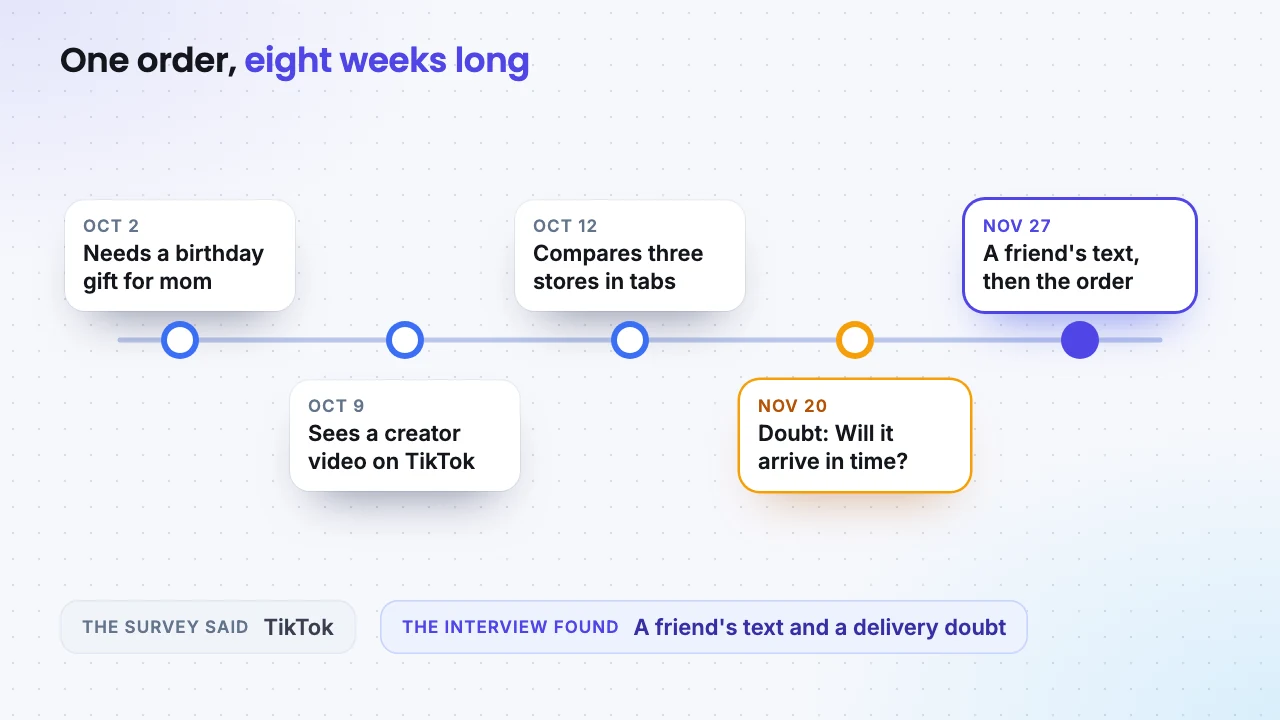
Ask what happened, not what they think
Most bad interview questions ask for an opinion, a promise or a yes. Rewrite them into questions about something that happened:
| Instead of | Ask | Why |
|---|---|---|
| "Why did you buy from us?" | "Take me back to the day you ordered. Where were you?" | A story brings back details. "Why" brings back a tidy reason |
| "Would you buy a monthly refill?" | "When you ran out last time, what did you do?" | What people did predicts better than what they promise |
| "Did you like the checkout?" | "What happened between adding to cart and paying?" | A yes or no question ends the story |
| "Was it the price or the shipping?" | "What almost stopped you?" | Two options in one question make them pick one of yours |
| "Isn't the gift box lovely?" | "What did you do with the box?" | A leading question gets agreement, not facts |
Inside the story, find out what happened, when, where, who with and how it felt, and ask why last. Asked after the details, why gets a truer answer than it does at the start.
When a buyer gets stuck
Sometimes a buyer can't find the words, feels awkward, or gives you the sensible version. These techniques help:
- Stay quiet for five seconds. After an answer, wait. People often fill the pause with the real reason.
- Repeat their words back. "Not worth it?" invites them to explain without you suggesting anything.
- Ask about other people: "Why do you think your friends haven't tried it yet?" People put their own doubts in other people's mouths.
- Finish the sentence: "People who buy from us are..." or "The thing I'd change about the box is..."
- The store as a person: "If our store walked into this room, who would it be? How old? What would they wear?" Then do the same for a competitor and compare.
- The first word: Say your store's name, then Amazon, then the drugstore, and ask for the first word that comes to mind for each.
- The sinking ship: "Imagine the product can keep only two of five things: The price, the full size, the scent, the box and fast shipping. Which go overboard first?"
Watch how people answer, too. A long pause, a "yes, but" or a laugh before a reply marks a spot worth one more question. Ask it gently: "You paused there. What were you thinking?"
Setup and ethics
- Ask for consent at the start: what you record, who will see it, and when you will delete it. Then keep that promise.
- Record the call so you can listen instead of typing. If you can, a second person takes notes with the camera off.
- Keep names apart from notes. Store the list of who you talked to separately from what they said.
- Don't sell during the interview. If a buyer asks about a discount, send it afterwards, with the thank you gift.
After the interviews
Within an hour of each call, write down the three things that surprised you, and anything the recording won't show, such as a hesitation or a change in tone. Once you have a few calls:
- Get transcripts, or at least notes by topic with timestamps for the moments that matter.
- Look for patterns: the same doubt, the same workaround, the same moment of decision in different stories.
- Group the patterns into a few themes you can act on.
- Write each insight with its tension: the situation, what the buyer wants and what they fear, what they do about it, and what you will change. A quote alone is not an insight.
- Report with words, not percentages. "Most buyers we talked to" is honest. "70% of buyers" from 10 calls is not.
The summary fits on one page, with whom you talked to, the three to five biggest insights and a quote for each, and what to do first.
Then count what you heard with a survey
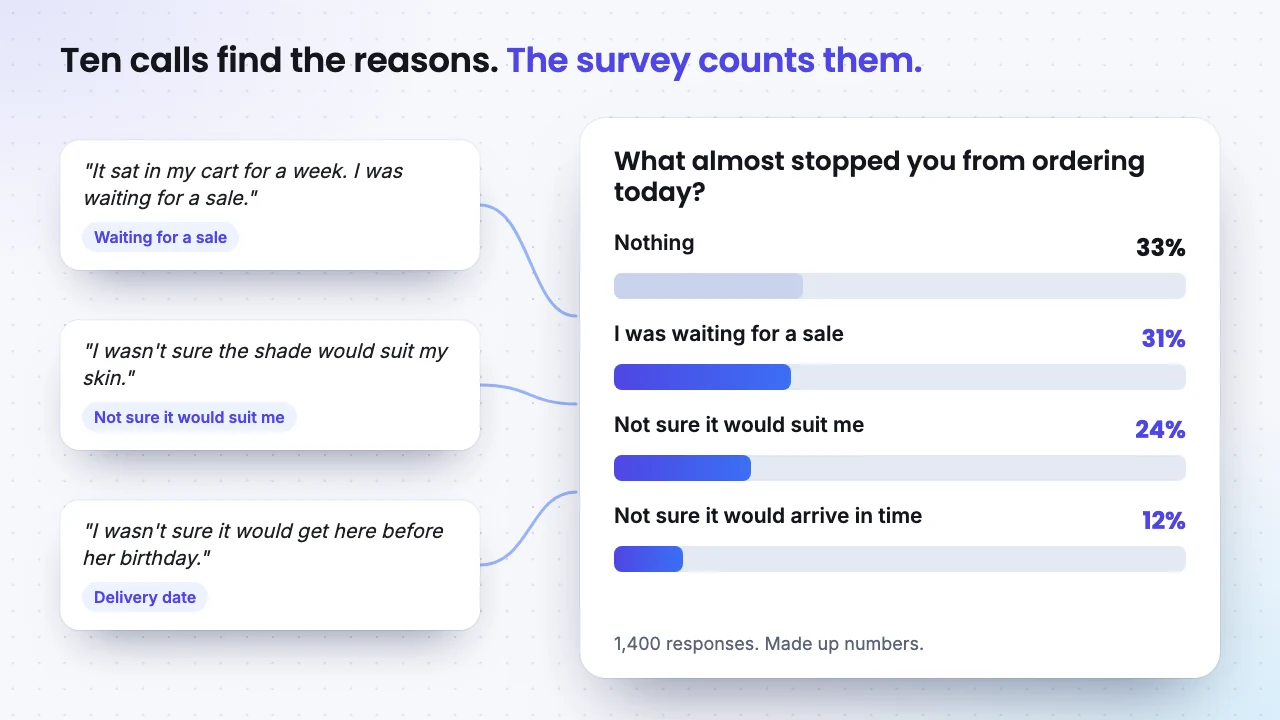
Ten interviews tell you which reasons exist. They don't tell you which reason is behind most orders. For that, turn what you heard into answer options and ask every buyer:
"It sat in my cart for a week. I was waiting to see if it would go on sale."
Waiting for a sale"I was waiting for a sale"
"My sister uses it, and her skin looked so good at her wedding."
Saw it work"I saw it work on someone I know"
"I wasn't sure it would get here before my mom's birthday."
Delivery date"Not sure it would arrive in time"
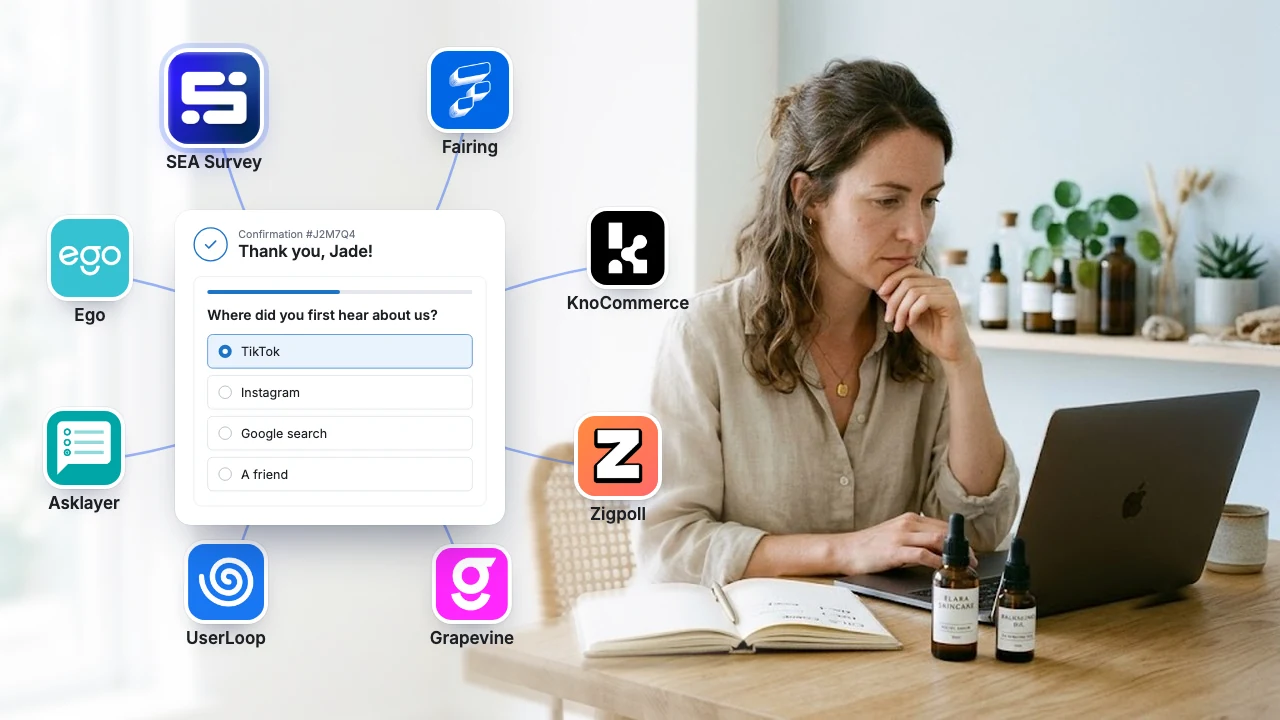
SEA Survey is a post purchase survey app for Shopify, and it helps before and after the calls. Before, its responses tell you whom to interview. Each response is saved on its order, so you can see the channel a buyer named, what almost stopped them, what they bought and whether they said yes to a call. On the Growth plan, logic can add a customer tag to every buyer who agrees, so you can find them in Shopify. After, the same post purchase survey app asks every buyer the question your interviews helped you write, and shows how many pick each answer next to the revenue of their orders. AI convert response on the Growth plan groups the written responses under "Other" into categories, so you can spot a reason the interviews missed. Read how to ask the first question well.

SEA Survey
Listed as SEA Post Purchase Survey Quiz, 4.9 stars from 188 reviews, with the Built for Shopify badge.
30% off any paid plan for 3 monthsStarter $13.30 instead of $19, Growth $34.30 instead of $49
BFCMSEA30Last day: Dec 7
- Why now: Black Friday buyers are the ones worth a call, and the best time to call is in the two weeks after their order. Add the questions before Nov 27, and your list is ready in early December.
- On the Free plan: 30 responses a month, with attribution, NPS and CSAT surveys.
- What a paid plan adds: Starter counts 500 responses a month. Growth has unlimited responses, customer tags from logic, AI convert response, the Marketing attribution dashboard and A/B testing.
- How to claim: Install SEA Survey from the Shopify App Store, open Plans, paste the code and pick Starter or Growth. Both start with a 7 day free trial.
Your interview checklist
- Write the one question the interviews should answer, such as "Why do gift buyers pick us over a department store?"
- Install a post purchase survey app and add three questions to the Thank you page, asking where they first heard about you, what almost stopped them, and whether they would join a call. SEA Survey has a Free plan, and code
BFCMSEA30takes 30% off any paid plan for 3 months, until Dec 7. - Pick one type of buyer and invite 10 to 12 who said yes, within two weeks of their order.
- Write the 45 minute guide, with most of the time on the order, step by step.
- Rewrite every opinion question into a question about what happened.
- Record with consent, and write three surprises after each call.
- Stop when two or three calls in a row bring nothing new.
- Group the patterns into themes and write the one page summary.
- Turn the themes into answer options and count them on the Thank you page.
FAQ
How long should an in depth interview be?
45 to 60 minutes. Shorter calls rarely reach the order itself. Longer ones tire the buyer, and the answers get thinner.
How many interviews are enough?
For one type of buyer and one clear question, 8 to 12. In a well known study, 6 interviews found 34 of the 36 main themes and the list stopped changing after 12. Stop when two or three calls in a row bring nothing new.
What is the difference between an in depth interview and a survey?
An interview follows one buyer's story to find reasons you didn't know about. A survey asks many buyers a short question to count how often each reason comes up. Interview first to find the answer options, then survey to count them.
Should I run interviews or a focus group?
Interviews for private topics, long decisions and one buyer's path. A focus group discussion for reactions to an idea, such as a new bundle or an ad, and the words buyers share.
Do I need a survey app to run interviews?
You can run interviews without one. A post purchase survey app makes two parts faster. Before the calls, it tells you which buyers to call and gets their yes on the Thank you page. Afterwards, it counts how many buyers share what you heard.