
In short
- SEO wins a ranked link, AEO wins Google's direct answer, and GEO wins a mention inside ChatGPT, Gemini or Perplexity.
- All three share a base: Google says its AI answers use pages already indexed for search, with no special files or markup.
- Each needs its own report, and none of them sees a shopper who read an answer and came back days later.
- One post purchase survey question counts all three, and each answer can start the work: FAQ answers for AEO, review requests for GEO.
One question, three places to answer it
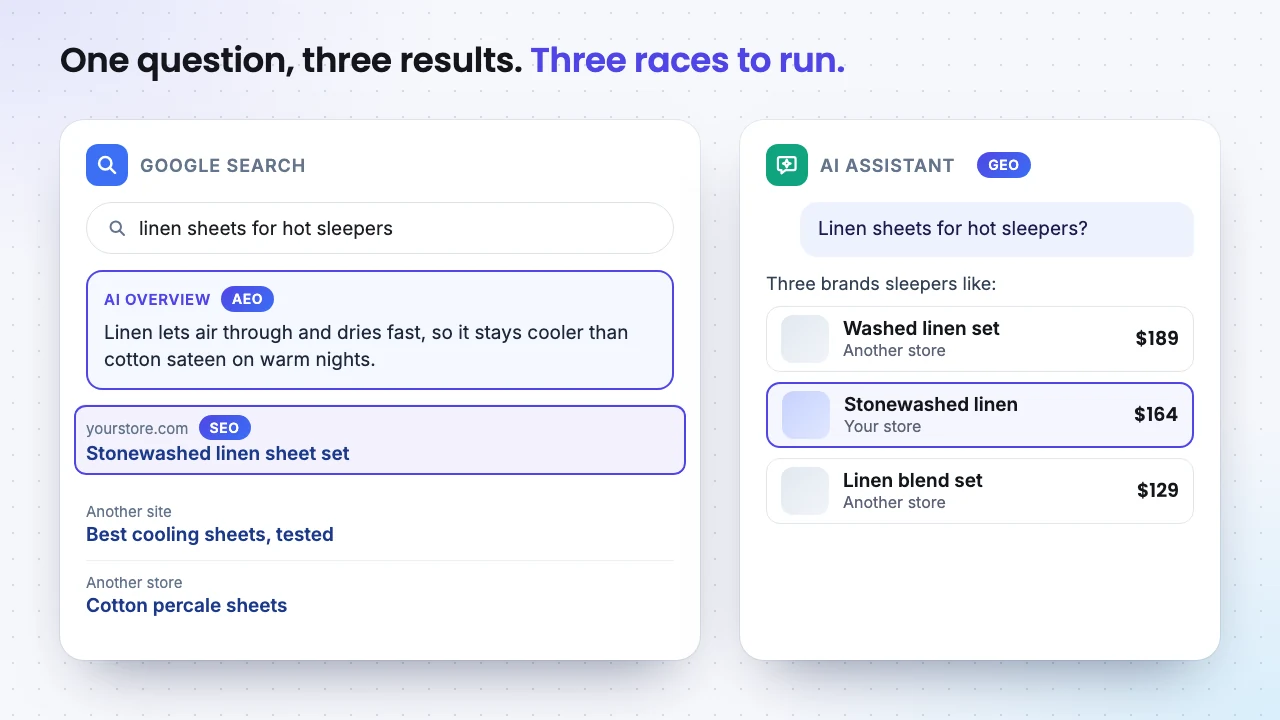
A shopper types "linen sheets for hot sleepers" into Google. Ten links sit on the page, an AI Overview sits above them, and the same question in ChatGPT returns three brands with a reason for each.
The links are where SEO competes, and fewer shoppers reach them. Tracking the browsing of 900 US adults in March 2025, Pew Research Center found users clicked a traditional result on 8% of visits that showed an AI summary and on 15% of visits without one. A link inside the summary got a click on 1%.
That leaves a store three races to run. SEO, search engine optimization, wins a ranked link. AEO, answer engine optimization, wins the direct answer, such as an AI Overview, a featured snippet or a voice reply. GEO, generative engine optimization, wins a mention and a citation inside an assistant's answer.
Many marketers use the last two names loosely, but they are not the same. AEO is about the answer taken from a store's own page. GEO is about the answer an AI writes from many sites, including reviews and threads the store does not write. AI Overviews count for both, because Google's AI writes them from several pages.
GEO vs AEO vs SEO at a glance
| SEO | AEO | GEO | |
|---|---|---|---|
| What it wins | A ranked link | The direct answer | A mention and a citation |
| Where it shows | Google and Bing results | AI Overviews, AI Mode, featured snippets, voice assistants | ChatGPT, Gemini, Perplexity, Microsoft Copilot, plus AI Overviews and AI Mode |
| What helps most | Relevant pages, links from other sites, speed | One clear answer per question, facts in plain text | Sources, quotes and numbers, plus reviews and mentions on other sites |
| What you control | Your own pages | Your own pages | Your pages, plus what others write about you |
| Where you measure it | Clicks and rankings in Search Console | Impressions in Search Console's generative AI report | GA4's AI Assistant channel and Shopify's Agentic page |
| What the buyer can tell you | "Google search results" | "Google's AI answer" | "ChatGPT or another AI tool", and what they asked |
SEO is still the base
Google treats its AI answers as part of search. A page qualifies for AI Overviews and AI Mode if it is indexed and eligible to show a snippet, and Google says no special optimizations, machine readable files or schema are needed.
Organic search also still brings the most visits. Shopify says organic search referred more sessions to its stores in the first quarter of 2026 than all the AI platforms it tracks combined, and same store organic sessions rose about 5%.
So the SEO basics carry over to the other two: Pages Google can crawl, titles that say what the page is, structured data that matches the visible text, and a Merchant Center feed kept up to date. Google lists the last two among the fundamentals for its AI features.
AEO wins the answer, not always the click
When an AI Overview appears, the top ranked page gets 58% fewer clicks, Ahrefs found in February 2026 across 300,000 keywords, up from a 34.5% drop in its April 2025 study. A store can supply the answer and still get no visit.
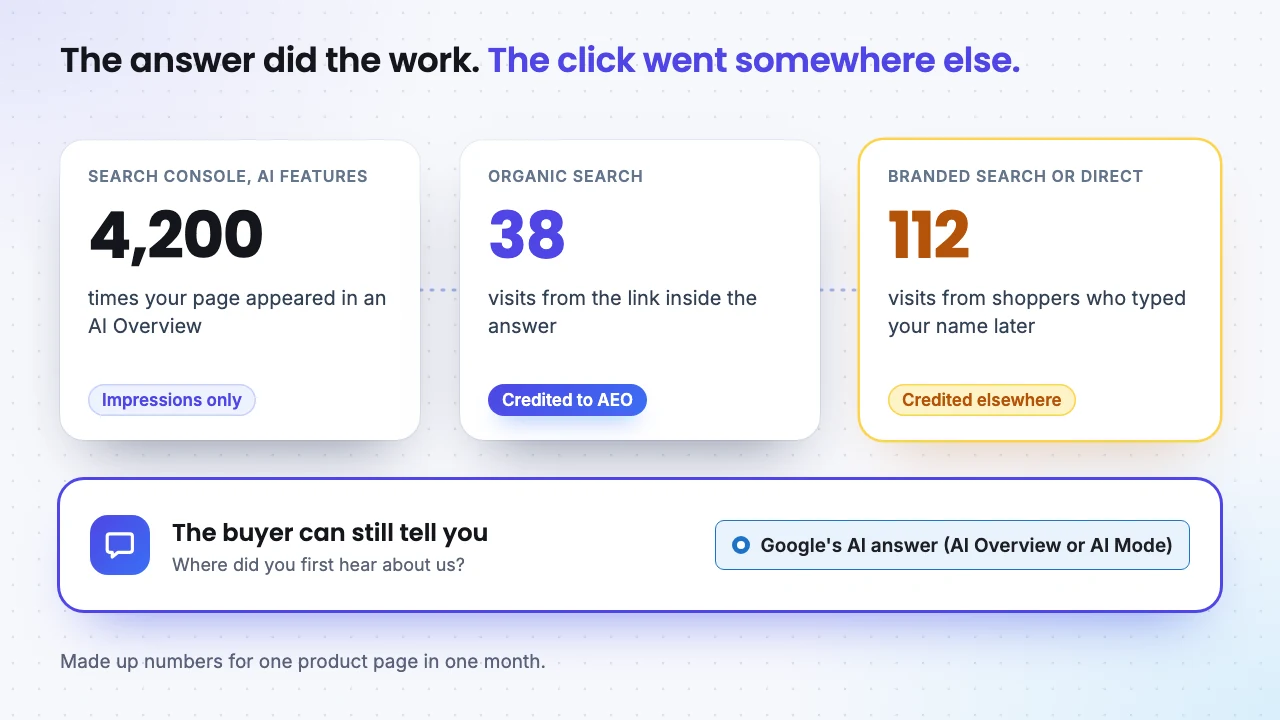
Search Console now counts part of what AEO earns. Its generative AI performance report, rolled out to every site by August 31, 2026, shows how often a site's pages appeared in Google's AI features, by page, country and date. It counts impressions, not the shoppers who read the answer and came back later.
Those shoppers return by typing the store's name or address and land in branded search or Direct. The AEO work won them, and the click report credits something else.
GEO depends on what others say
Assistants build an answer from many sites, so a brand's own pages are only part of what they read. Shopify's GEO guide names reviews, press and community threads such as Reddit next to clean product data.
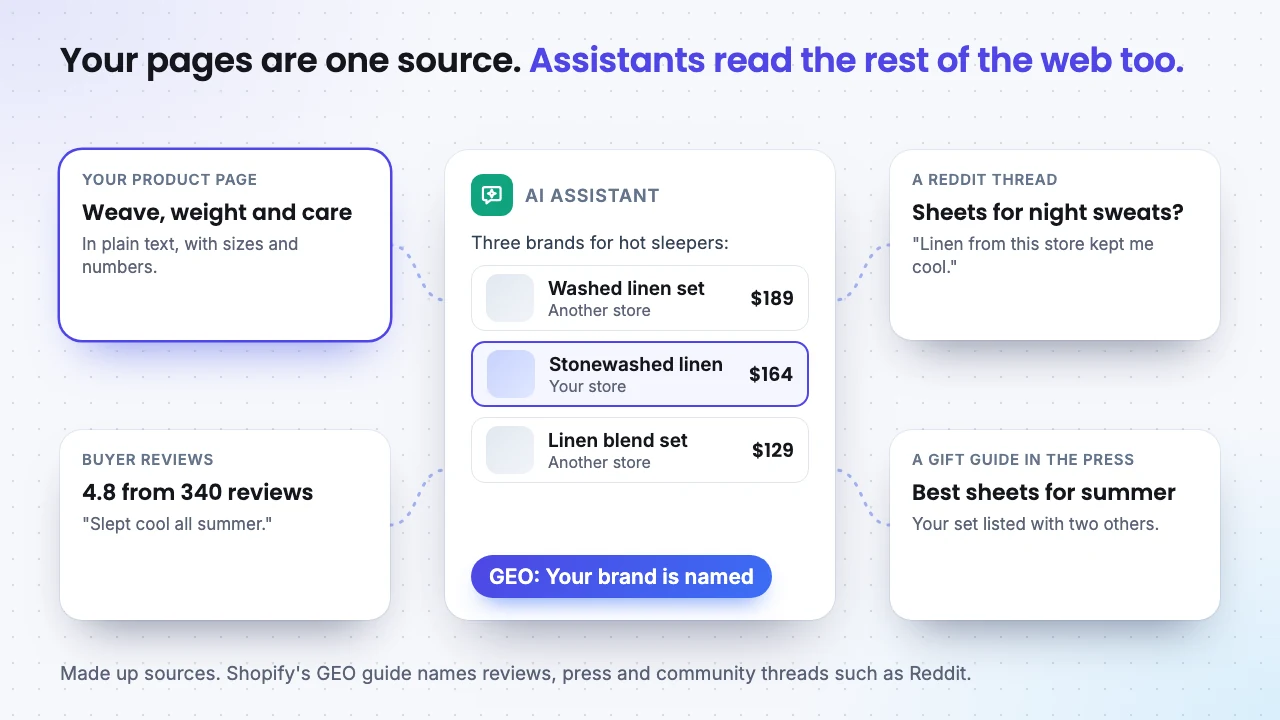
The content still counts. In a 2024 study, researchers from Princeton and IIT Delhi found that citing sources, adding quotations and adding statistics raised a page's visibility in generative engine answers by up to 40%, while keyword stuffing did not help. GEO and AEO for Shopify shows what that means on a product page.
GEO is also the easiest of the three to see in reports. GA4 added an AI Assistant channel on May 13, 2026, and Shopify's Agentic page shows sales from AI channels, including orders paid inside the chat. Both miss the shopper who reads an answer on Monday and types the store's address on Tuesday.
One question counts all three
Each report above sees one surface. The buyer saw all of them, and one question on the Thank you page lets them say which one sent them.
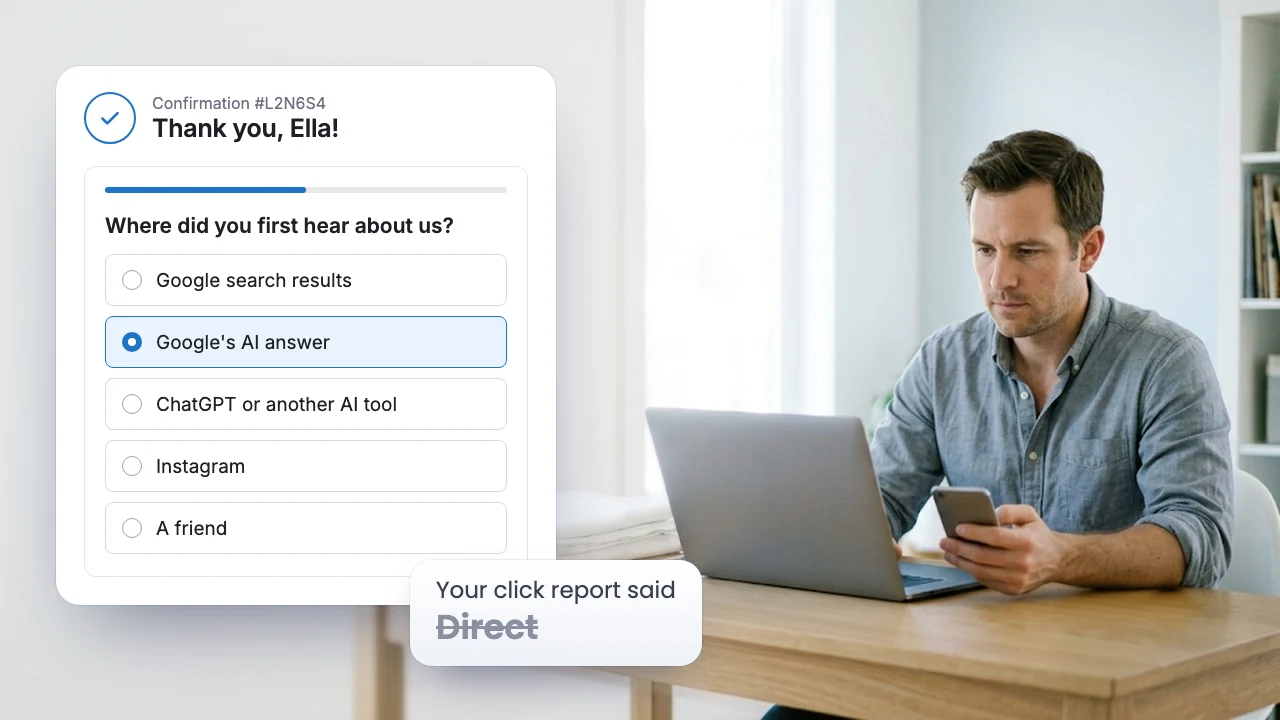
SEA Survey is a post purchase survey app for Shopify, and it saves each response on its order, next to its revenue. Splitting the old "Google search" option in two shows how many buyers an AI Overview sent, a number no click report gives.
Buyers who pay inside Copilot, AI Mode or Gemini may never see the Thank you page, so the same question goes out by post purchase email, which SEA Survey sends after every new order on every plan.
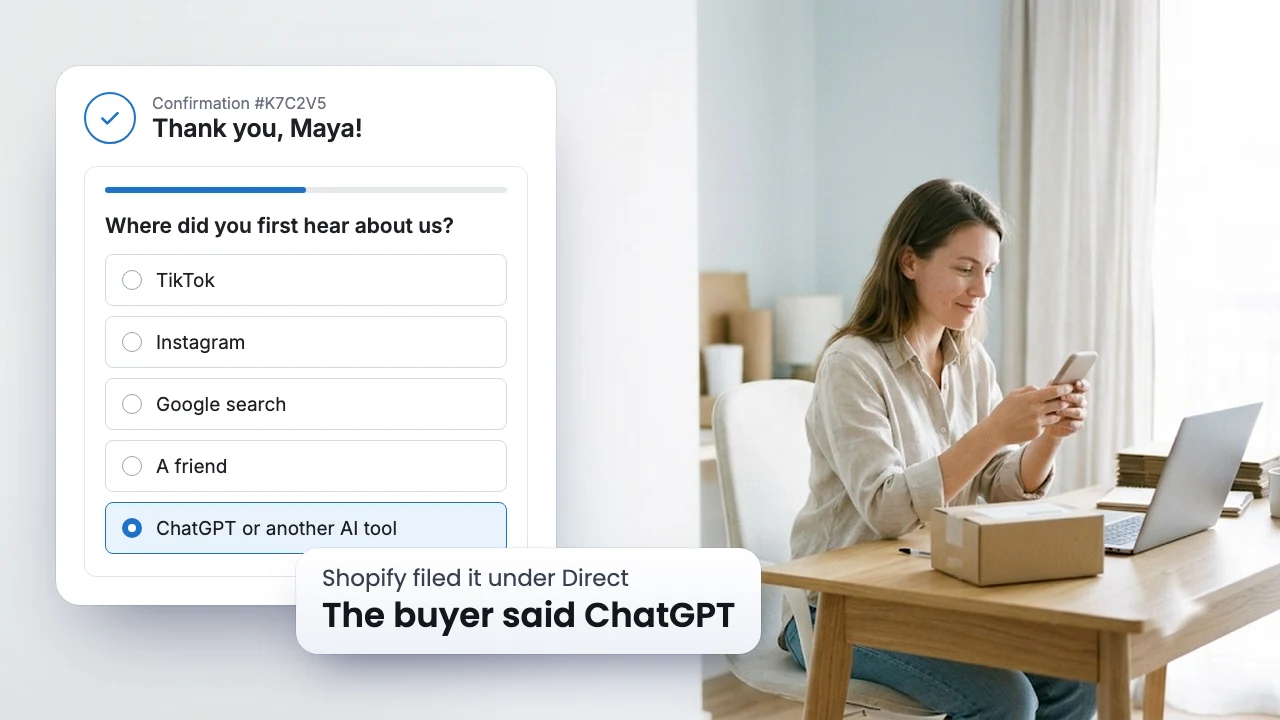
Each answer can also start the work on the race that sent the buyer. On the Growth plan, a buyer who picks an AI option sees one more question, "What did you ask?", and AI Convert Responses groups the replies into topics. The top questions become FAQ answers on the product page, in the words buyers used, so the page answers the questions shoppers ask.
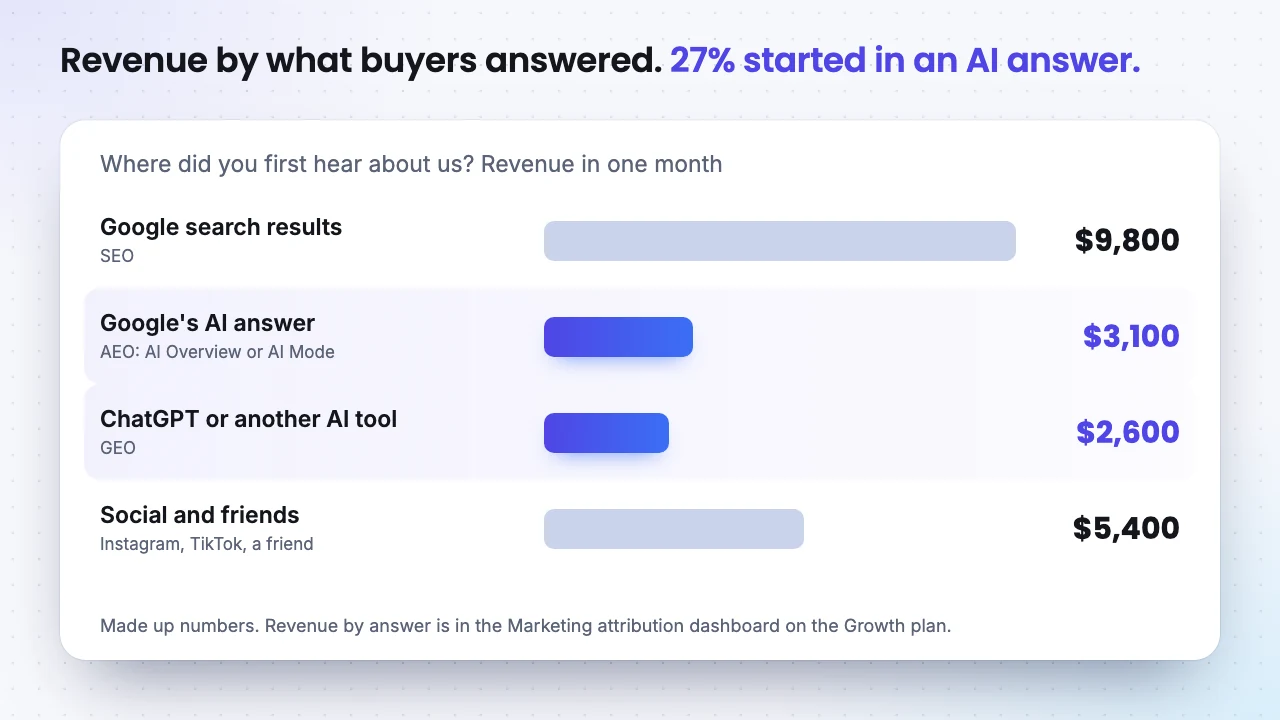
The same answer adds a customer tag, and the tag puts the buyer in a segment in your email marketing or CRM tool. A flow there asks for a review after delivery, and reviews are one of the signals Shopify's GEO guide names. The Marketing attribution dashboard then shows revenue by answer, so the store sees which of the three races pays.
Where to start
The survey answers set the order of work. If most buyers name Google search results, SEO still pays the bills and comes first. A growing share for Google's AI answer points to answer first product pages and FAQs, and a growing share for AI tools points to reviews, mentions and clean product data.
Adobe expects traffic from AI tools to US retail sites to rise 130% this holiday season, with the biggest jump on Thanksgiving. Adding the two AI options now gives a November baseline to set against Cyber Monday week.
SEA Survey has a Free plan, and code BFCMSEA30 takes 30% off any paid plan for 3 months, until Dec 7.

SEA Survey
Listed as SEA Post Purchase Survey Quiz, 4.9 stars from 191 reviews, with the Built for Shopify badge.
30% off any paid plan for 3 monthsStarter $13.30 instead of $19, Growth $34.30 instead of $49
BFCMSEA30Last day: Dec 7
- Why now: Split "Google search" into results, AI answers and AI tools before Nov 26, and the holiday rush shows which of SEO, AEO and GEO brings your buyers.
- On the Free plan: 30 responses a month, with attribution, NPS and CSAT surveys, on the Thank you page and by post purchase email.
- What a paid plan adds: Starter counts 500 responses a month. Growth has unlimited responses, conditional logic, customer tags, integrations and the Marketing attribution dashboard with revenue by answer.
- How to claim: Install SEA Survey from the Shopify App Store, open Plans, paste the code and pick Starter or Growth. Both start with a 7 day free trial.
FAQ
Is SEO dead because of AI search?
No. Google's AI Overviews and AI Mode draw on pages indexed for search, and Shopify says organic search still sends more sessions than all AI platforms combined.
Are AEO and GEO the same thing?
No, though many marketers use the names loosely. AEO is about the answer taken from your page, as in a featured snippet. GEO is about the answer an AI writes from many sites, as in ChatGPT. Google's AI Overviews count for both.
Can one tool track SEO, AEO and GEO together?
No single report does. Search Console covers SEO and Google's AI features, GA4 and Shopify cover AI referrals, and a post purchase survey covers what the buyer saw.