
In short
- GEO gets your brand named in ChatGPT, Gemini and Perplexity answers, and AEO gets your page used as Google's direct answer.
- Google says AI Overviews and AI Mode need no special files or markup, only indexed pages that answer questions with facts.
- Sources, quotes and numbers raised a page's visibility in AI answers by up to 40% in one study, while keyword stuffing did not.
- A post purchase survey app collects the questions buyers asked the AI, and turns happy buyers into new reviews.
The answer is the new shop window
A shopper types "carry on backpack that fits under a plane seat" into Google, and an AI Overview answers before the first link. Asked the same thing, ChatGPT names three brands, each with a line on why it fits.
Those answers already send buyers. Shopify says sessions referred by AI chat tools to its stores grew more than eightfold in the year to the first quarter of 2026, and orders from them nearly thirteenfold.
The shoppers who arrive that way convert at nearly 50% higher rates than organic search and spend 14% more per order, Shopify found, and more than half land straight on a product page. A store the answer leaves out never gets the visit.
Two names cover the work of getting into those answers. GEO, generative engine optimization, aims to get a brand named and cited by assistants such as ChatGPT, Gemini and Perplexity. AEO, answer engine optimization, aims to get a page used as the direct answer, in Google's AI Overviews, a featured snippet or a voice assistant.
The two overlap, but they are not the same. AEO is about the answer taken from your page. GEO is about the answer an AI writes from many sites. Google's AI Overviews count for both.
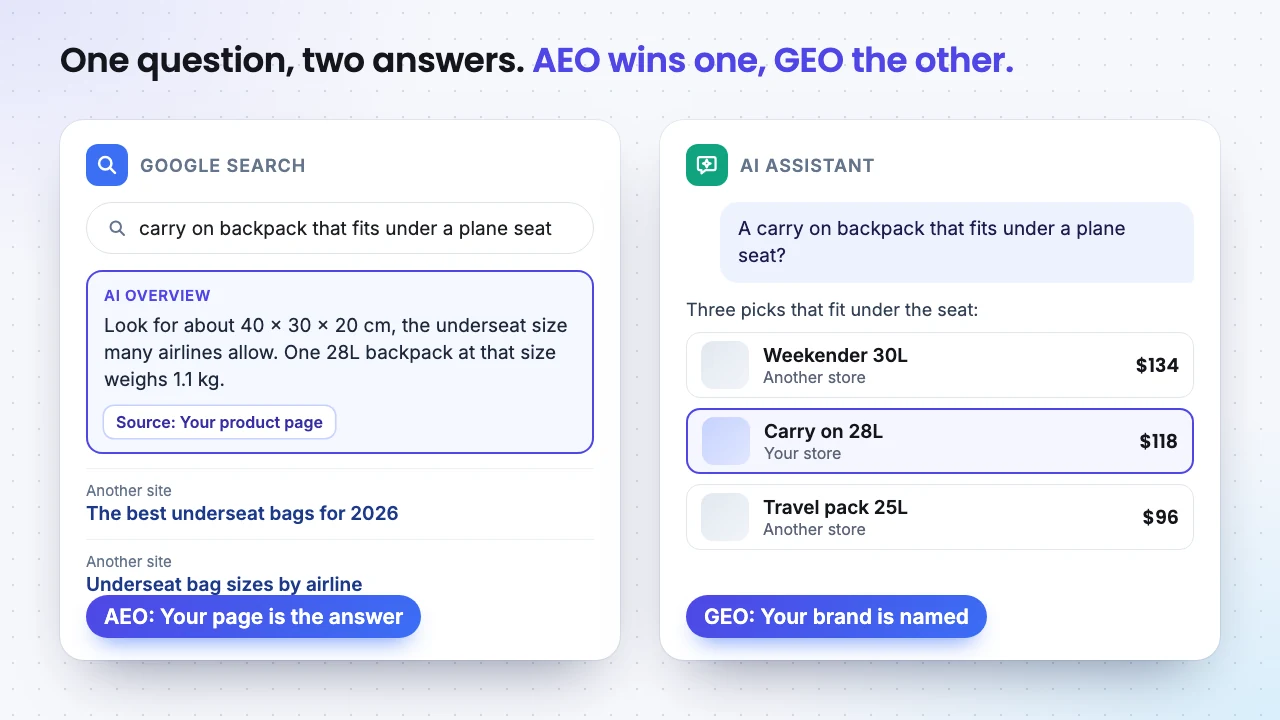
What AI engines read on a store
Google's rule is short. There are "no additional requirements to appear in AI Overviews or AI Mode, nor other special optimizations necessary", its Search Central guide says, and no new machine readable files, AI text files or schema markup. A page has to be indexed and eligible to show a snippet, as in ordinary search.
What lifts a page is evidence. Researchers from Princeton and IIT Delhi rewrote web pages and measured how often generative engines used them, in a study presented at the KDD conference in 2024. Citing sources, adding quotations and adding statistics raised visibility by up to 40%, while keyword stuffing, an old SEO habit, did not help.
On a product page, evidence means facts in plain text that a machine can quote: Dimensions, materials, care, delivery times and who the product suits. Shopify's GEO guide adds clean product data, with variants grouped under one parent product, a specific category, and a robots.txt file that does not block the pages you want found.
That data now travels beyond the store. Shopify's Agentic Storefronts, announced in December 2025, use Shopify Catalog to bring products into AI channels such as ChatGPT and Microsoft Copilot, so the same fields feed your pages and the assistants.
The last signal sits off your site. Search rankings rest mostly on your own pages, while assistants also weigh what others say about a brand, and Shopify's guide names reviews, press and community threads such as Reddit.
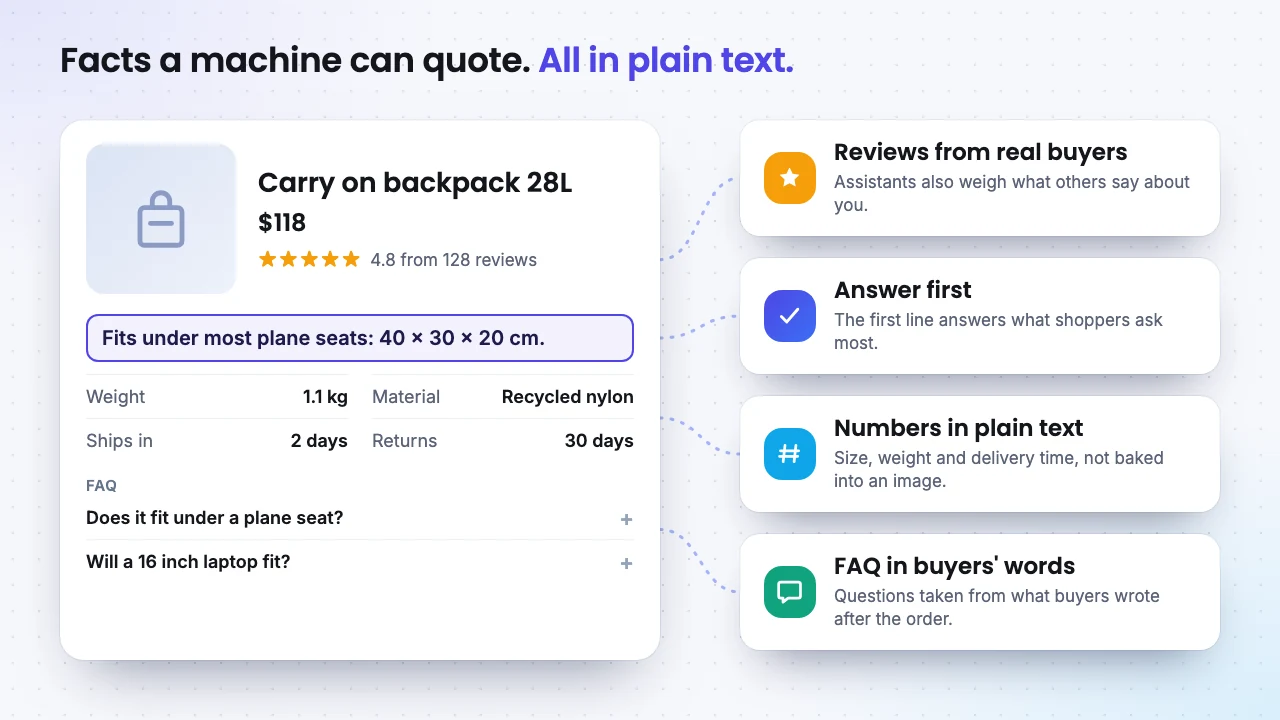
The questions only your buyers know
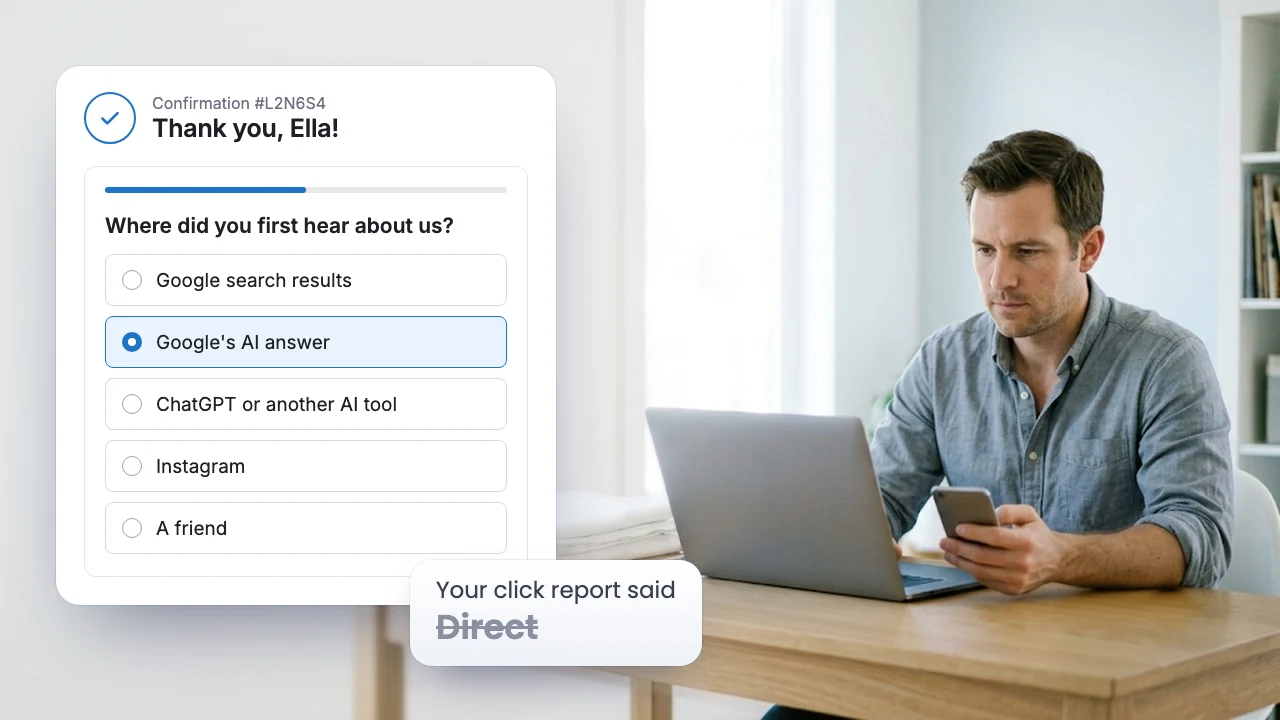
Search Console shows the words people typed into Google. No report shows what a shopper typed into ChatGPT, because assistants do not pass the question to your store, and that is the list GEO and AEO work needs most.
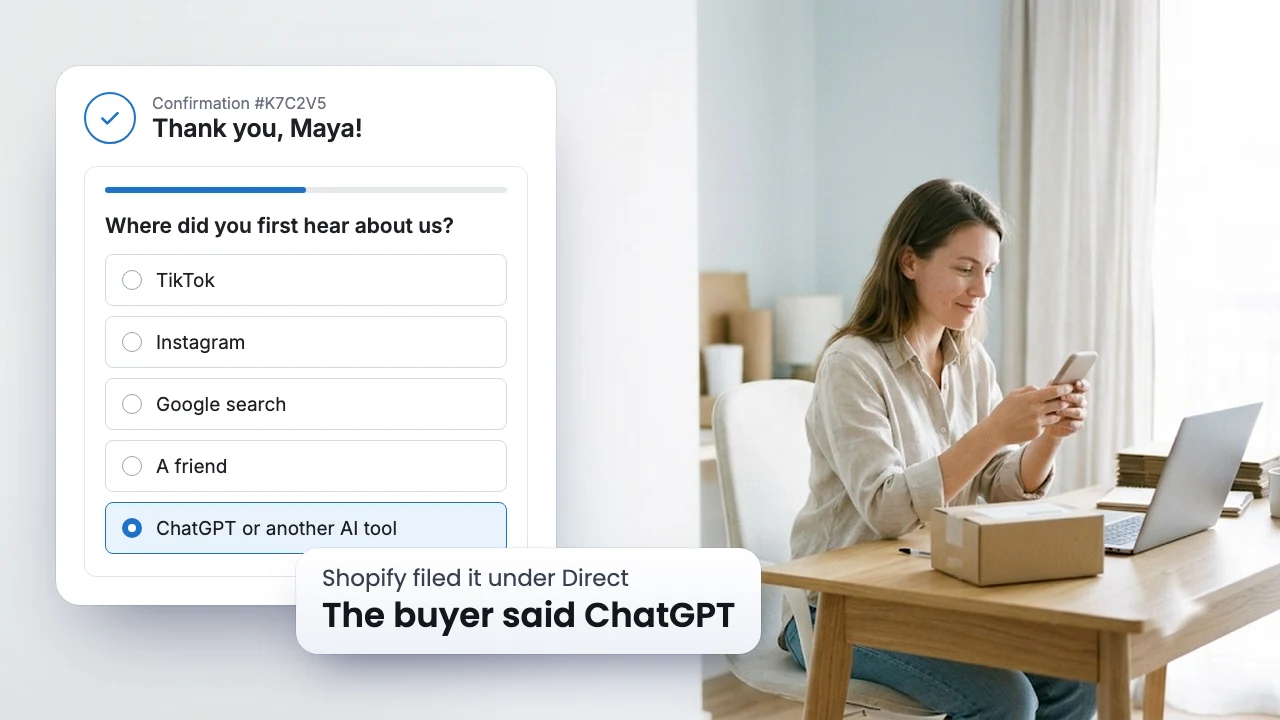
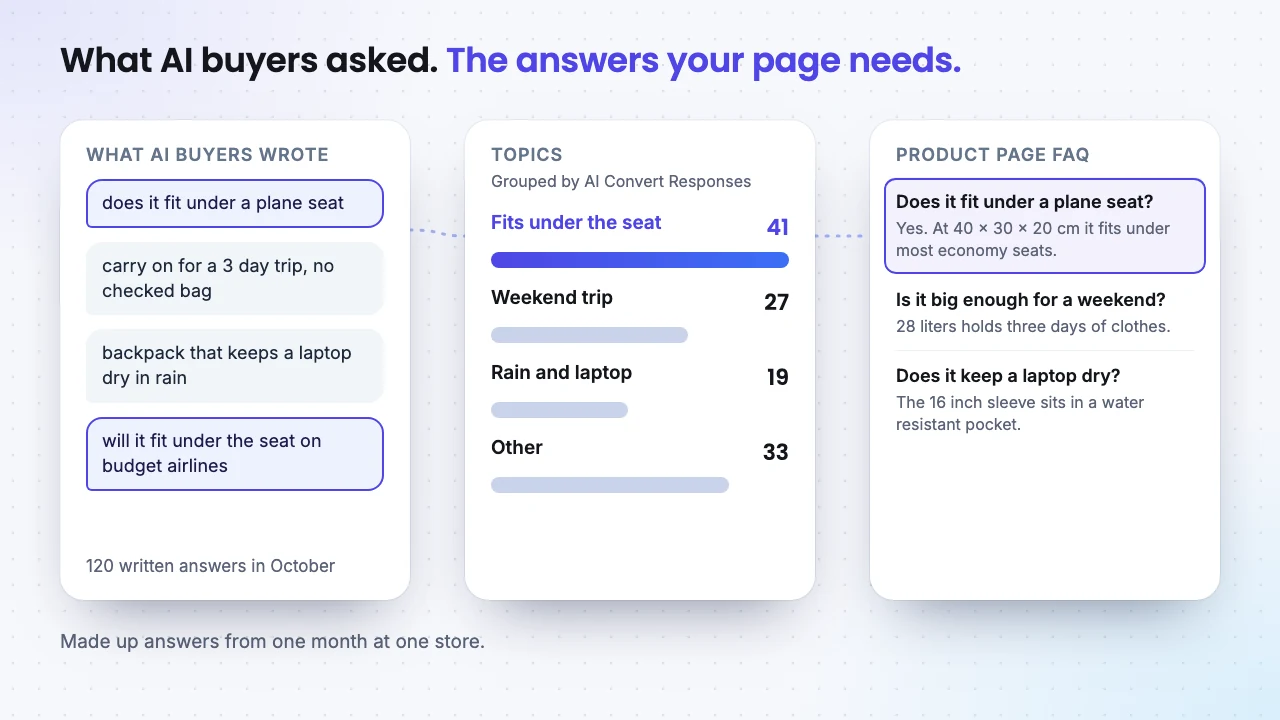
The buyer can tell you. SEA Survey is a post purchase survey app for Shopify, and two questions after the order fill that gap: Which buyers came from an AI tool, and what they asked it.
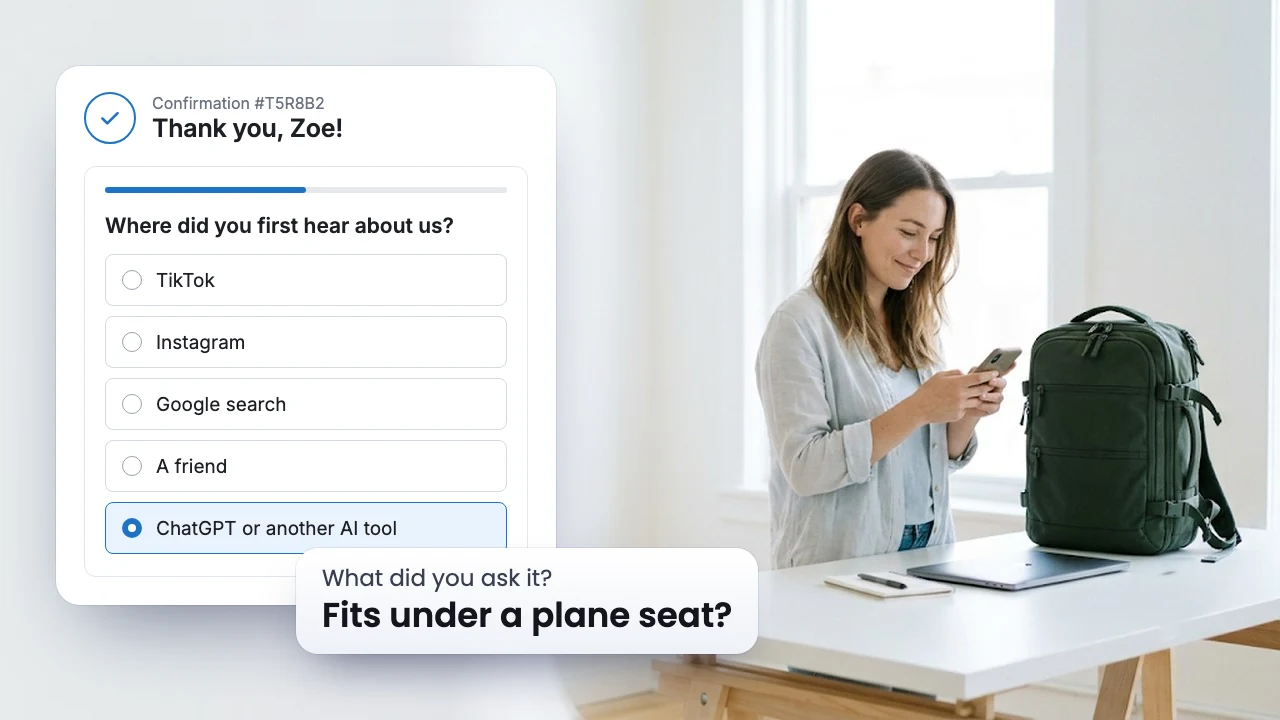
Buyers who pick "ChatGPT or another AI tool" then see "What did you ask it?", shown only to them through conditional logic on the Growth plan. On the Free and Starter plans, the same survey can ask every buyer "What were you looking for when you found us?" instead.
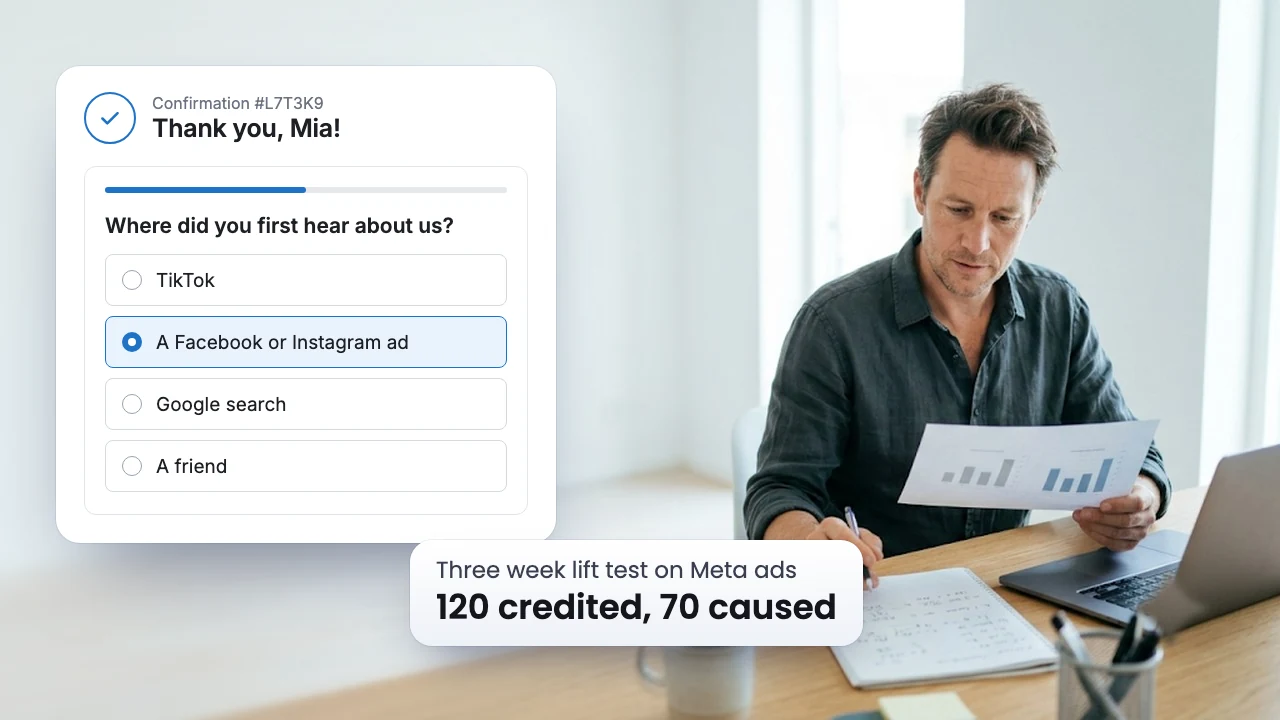
AI Convert Responses groups the written answers into topics. Say 120 buyers named an AI tool in October and 41 of them asked whether the bag fits under a plane seat. That answer, with the exact size, moves to the first line of the product page and into its FAQ, in the words buyers used.
A second question, "What almost stopped you from buying today?", fills the rest of the FAQ with sizing, shipping time, care and returns. Each common doubt becomes a short question with a direct answer, the shape AI Overviews and assistants quote.
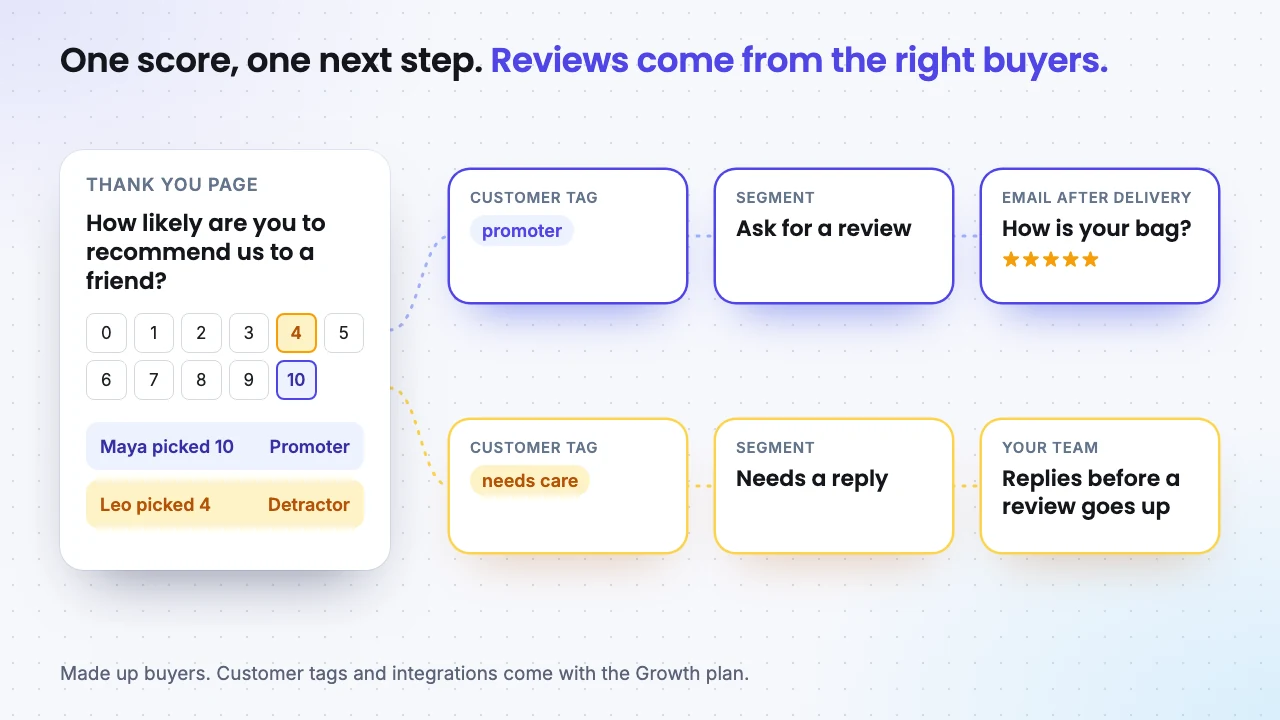
From a happy buyer to a review
Reviews are the part of GEO a store cannot write itself, so the work is asking the right buyers at the right time. A Net Promoter Score question on the Thank you page sorts buyers as they answer, with 9 or 10 as promoters and 0 to 6 as detractors.
On the Growth plan, SEA Survey turns that answer into an action. A score of 9 or 10 adds a customer tag, and the tag puts the buyer in a segment in your email marketing or CRM tool. A flow there asks for a review once the order arrives.
A score of 0 to 6 adds a different tag, so the team can reach the buyer before an unhappy review goes public. Each response is saved on its order with the revenue, so the store sees which complaints come from its biggest orders.
The same survey shows whether the work pays off. Buyers who name an AI tool, set against GA4's AI Assistant channel and Shopify's Agentic page, give three counts that should rise as GEO and AEO take hold. How to measure sales from AI shopping assistants explains how to read them, and GEO vs AEO vs SEO compares the three disciplines.
Before the holiday rush
Adobe expects traffic from AI tools to US retail sites to rise 130% this holiday season, with the biggest jump, 159%, on Thanksgiving. A first round fits in one week:
- In your post purchase survey app, add "ChatGPT or another AI tool" to "Where did you first hear about us?" and a written question after it.
- Read the first 50 written answers and put the three most common questions, with direct answers, near the top of each product page.
- Move sizes, materials and delivery times out of images and into plain text.
- On the Growth plan, tag buyers who score 9 or 10 and send them a review request from your email marketing tool.
SEA Survey has a Free plan, and code BFCMSEA30 takes 30% off any paid plan for 3 months, until Dec 7. The questions buyers ask over Thanksgiving week become the product page answers for January.

SEA Survey
Listed as SEA Post Purchase Survey Quiz, 4.9 stars from 191 reviews, with the Built for Shopify badge.
30% off any paid plan for 3 monthsStarter $13.30 instead of $19, Growth $34.30 instead of $49
BFCMSEA30Last day: Dec 7
- Why now: AI answers change with what shoppers ask. Add the AI option and the written question before Nov 26, and Thanksgiving buyers hand you the questions to answer on your product pages.
- On the Free plan: 30 responses a month, with attribution, NPS and written questions, on the Thank you page and by post purchase email. AI Convert Responses sorts the written answers into topics.
- What a paid plan adds: Starter counts 500 responses a month. Growth has unlimited responses, conditional logic, customer tags and the integrations that start a review flow in your email marketing or CRM tool.
- How to claim: Install SEA Survey from the Shopify App Store, open Plans, paste the code and pick Starter or Growth. Both start with a 7 day free trial.
FAQ
Is GEO different from SEO?
It builds on it. Google's AI Overviews and AI Mode use pages already indexed for search, while assistants such as ChatGPT also weigh reviews and mentions on other sites.
Do I need an llms.txt file?
Not for Google, which says no AI text files, new machine readable files or special schema are needed to appear in AI Overviews or AI Mode.
Can I see what shoppers asked ChatGPT about my products?
Not in GA4, Search Console or Shopify, because assistants do not pass the question on. A written question after the order collects it from the buyer.